
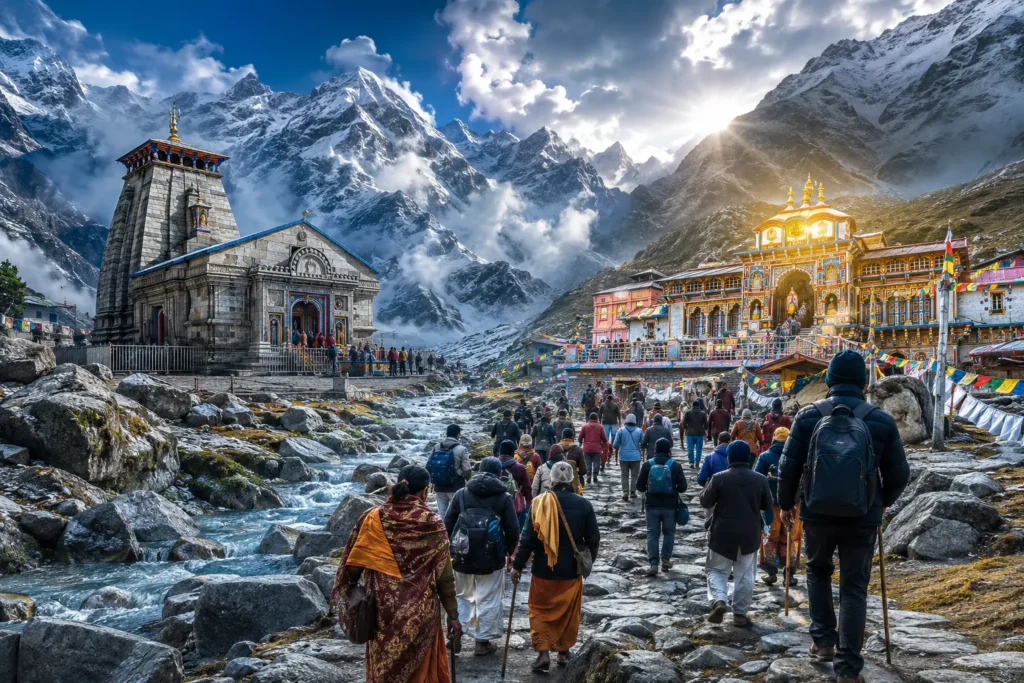
There’s a reason people don’t just “visit” Kedarnath and Badrinath — they say they “did” the yatra, the way one might describe surviving something life-changing. Tucked deep in the Garhwal Himalayas of Uttarakhand, these two shrines sit at the heart of India’s most demanding and most revered pilgrimage circuit. No flight lands anywhere close. No road goes all the way. For Kedarnath, you walk, climb, or take a pony for the final stretch — and somehow, that’s exactly the point.
If you’ve ever wondered why lakhs of pilgrims, including the elderly and the unwell, willingly take on a 16-kilometre Himalayan trek every single year, this blog will walk you through what makes Kedarnath and Badrinath so spiritually significant, what to expect at each destination, the best time to plan this yatra, and how a well-organised 10-day journey from Sangli can take care of every logistical headache so all you have to focus on is the darshan itself.
Why Kedarnath and Badrinath Hold Such a Special Place in Hindu Pilgrimage
Kedarnath and Badrinath are two of the four sacred sites that make up the Char Dham — the four divine abodes that every devout Hindu is encouraged to visit at least once in their lifetime, alongside Yamunotri and Gangotri. But their importance goes even deeper than that.
Kedarnath is one of the twelve Jyotirlingas of Lord Shiva, considered among the most powerful and difficult to reach of them all. Legend says the temple was built by the Pandavas themselves, who came here seeking forgiveness from Lord Shiva after the Kurukshetra war. Shiva, wanting to avoid them, is said to have taken the form of a bull and dived into the ground at this very spot, which is why the temple’s sanctum houses a naturally formed, conical Shiva linga rather than a carved idol.
Badrinath, on the other hand, is dedicated to Lord Vishnu and is one of the four sacred Char Dham sites as well as part of the 108 Divya Desams revered by Vaishnavites. It is believed that Lord Vishnu meditated here under a Badri (wild berry) tree, with Goddess Lakshmi shielding him from the harsh elements in the form of the same tree — which is how the place got its name. The temple is also one of the Panch Badri shrines and sits at the source of the river Alaknanda, with the Neelkanth peak rising majestically behind it.
Together, a yatra to Kedarnath and Badrinath is seen as one of the most complete spiritual journeys a devotee can undertake — one shrine representing Shiva’s fierce, ascetic energy at the edge of human endurance, and the other representing Vishnu’s calm, preserving grace in the lap of the mountains.
A Closer Look at Each Sacred Stop Along the Way
Haridwar — The Gateway to the Gods
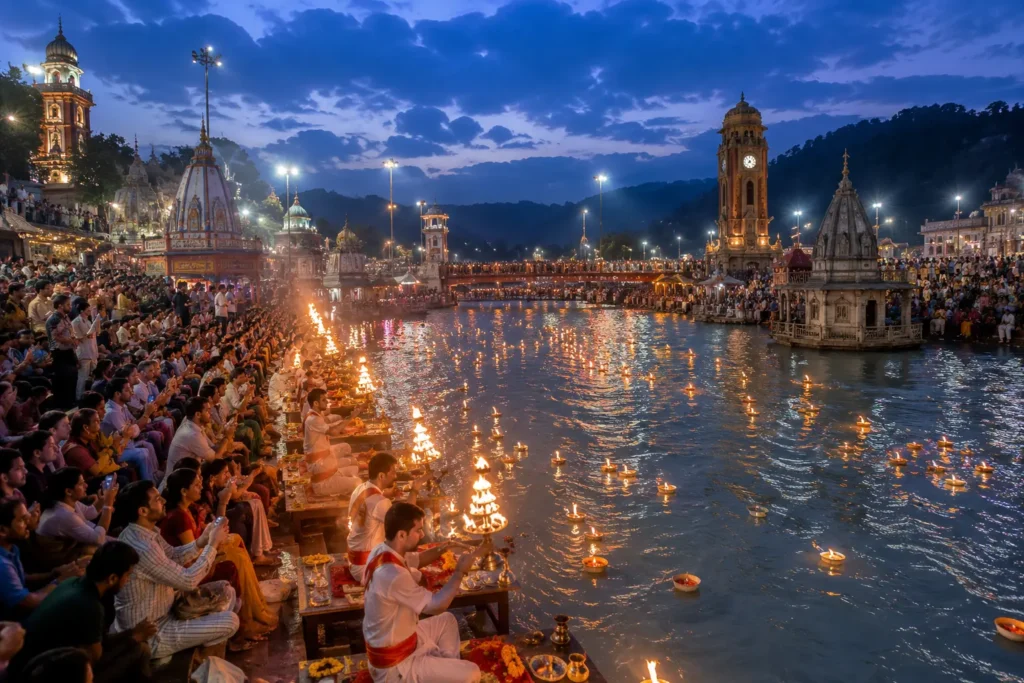
Haridwar is often called the gateway to Char Dham, sitting right where the Ganga leaves the Himalayas and enters the plains. The evening Ganga Aarti at Har Ki Pauri, with thousands of diyas floating on the river and the air filled with bells and chants, is an experience that sets the tone for the entire yatra ahead.
Rishikesh — The Yoga Capital on the Ganga
Just a short drive from Haridwar, Rishikesh is known worldwide as the yoga capital of the world, but for pilgrims it’s equally significant for Ram Jhula and Laxman Jhula, the iconic suspension bridges across the Ganga, along with numerous ashrams that line its banks.
Guptkashi — The Hidden Kashi
Guptkashi serves as the main base town before the final push to Kedarnath. According to legend, Lord Shiva hid here briefly to avoid the Pandavas, which is how the town came to be known as the “hidden Kashi.” It’s also where most pilgrims spend a night acclimatising before the trek.
Kedarnath — The Jyotirlinga at the Edge of the Sky
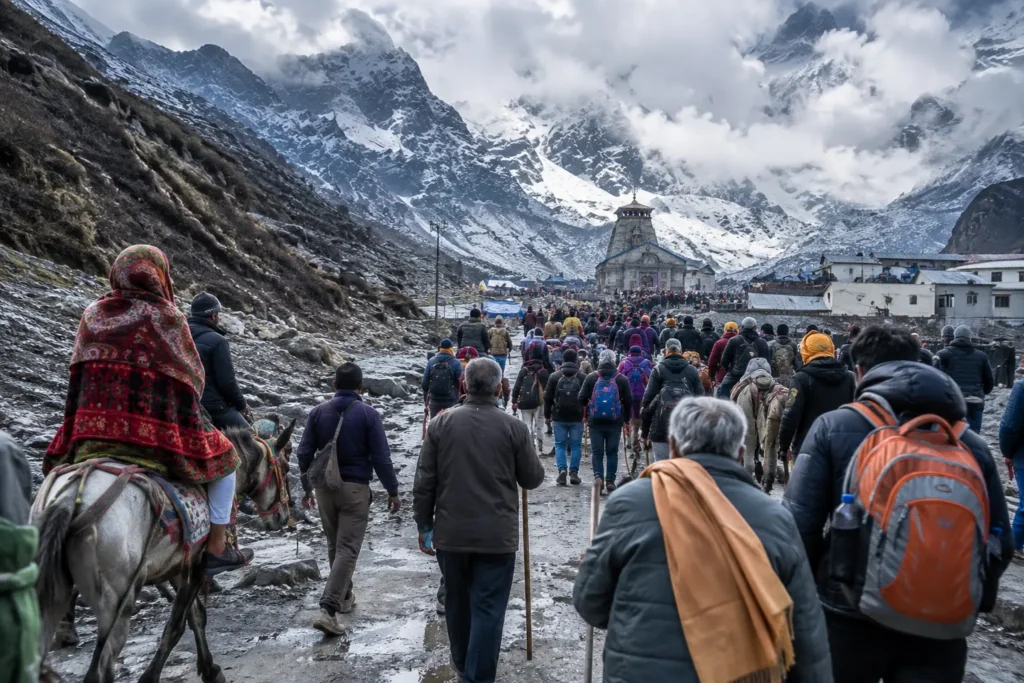
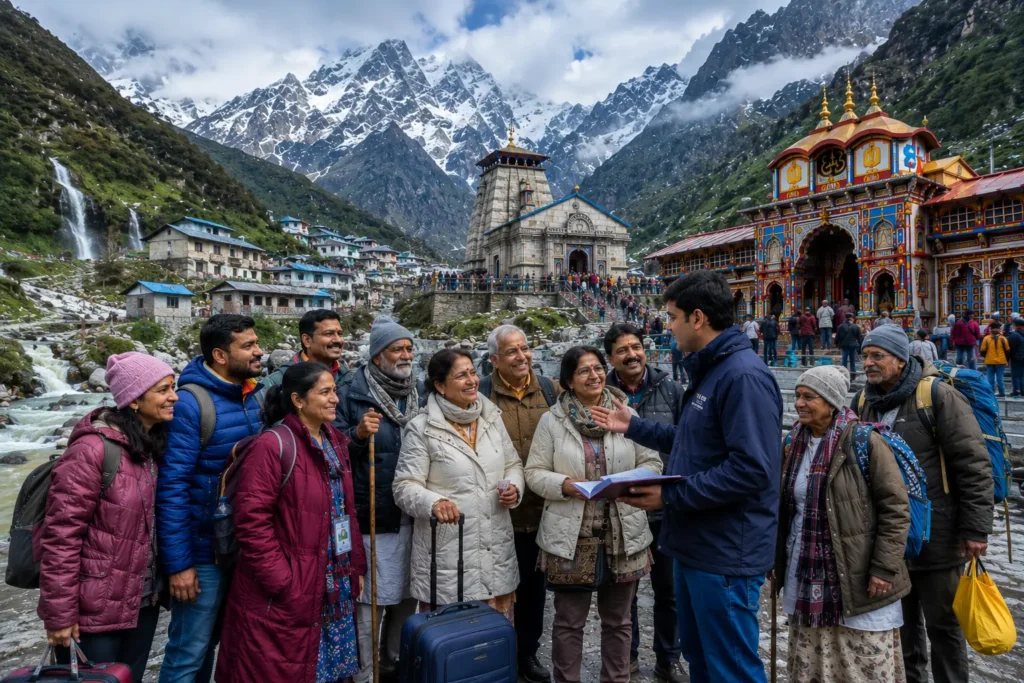
Sitting at over 3,500 metres, with snow-capped peaks forming a dramatic backdrop, Kedarnath Temple is reached after a roughly 16-kilometre trek from Gaurikund. The climb is genuinely demanding, but pilgrims consistently describe the moment the temple finally comes into view as one of the most overwhelming experiences of their life.
Mana Village — India’s Last Village
Just beyond Badrinath lies Mana, officially recognised as the last Indian village before the Tibet border. It’s associated with sage Ved Vyasa and the Mahabharata, and is also home to the dramatic Vasudhara Falls and the spot believed to be where the Saraswati river disappears underground.
Badrinath — The Abode of Lord Vishnu in the Himalayas
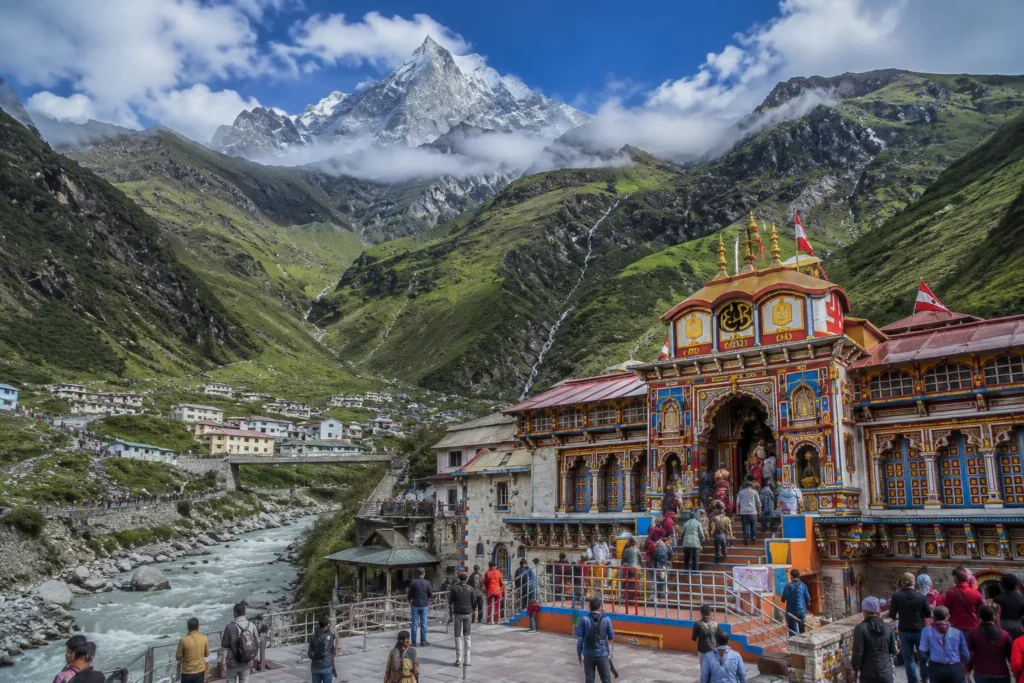
Surrounded by the Nar and Narayan mountain ranges, with the Alaknanda flowing right past it, Badrinath Temple is one of the holiest Vishnu shrines in the country. Unlike Kedarnath, it’s directly accessible by road, making the darshan experience here comparatively easier on the body, even as it remains just as powerful spiritually.
Best Time to Visit Kedarnath and Badrinath
Both temples open only for a few months each year and remain shut through the harsh Himalayan winter, when the entire region is buried under snow. The temples typically open around late April (close to Akshaya Tritiya) and close around early to mid-November, around the time of Bhai Dooj, after which the deities are ceremonially moved to their winter seats.
Within this window, May–June and September–October are widely considered the best months to visit. May and June offer pleasant weather before the monsoon sets in, while September and October bring clearer skies, fewer crowds compared to peak summer, and far more comfortable trekking conditions after the rains have passed. Late August and early September, in particular, strike a good balance — the heaviest monsoon rains have largely eased, the rush of the peak summer season has thinned out, and the mountains are at their greenest.
A 10-Day Kedarnath-Badrinath Yatra, Thoughtfully Planned from Sangli
A yatra like this involves a lot of moving parts — long train journeys, mountain roads, high-altitude treks, and unpredictable weather — and getting the sequencing right matters as much as the destinations themselves. For pilgrims travelling from Sangli, Sam Holidays has put together a 10-day Kedarnath-Badrinath yatra departing on 30th August 2026 and concluding on 9th September 2026, designed to give the body enough time to acclimatise before the trek while keeping the overall journey efficient.
Here’s how the days unfold: the yatra begins with an overnight train from Sangli to Delhi, followed by a drive to Haridwar with the evening Ganga Aarti. The next day moves to Guptkashi via Rishikesh, taking in Ram Jhula and Laxman Jhula along the way. From Guptkashi, pilgrims trek to Kedarnath for darshan and an overnight stay, before returning to Guptkashi the following day. The route then continues to Pipalkoti, from where Badrinath and Mana Village are covered in a single day, with the return journey running back through Haridwar to Delhi and finally home to Sangli by train.
The package, priced at ₹19,900 per person, includes Miraj-Delhi-Miraj train tickets in AC sleeper class, four-sharing hotel accommodation (dormitory stay at Kedarnath itself), six breakfasts and six dinners (strictly vegetarian), all local sightseeing and transfers by traveller vehicle, all toll, tax, parking, driver allowance and fuel costs, a dedicated tour manager, and complete assistance with yatra registrations — a requirement that’s now mandatory for both Kedarnath and Badrinath and easy to get wrong if you’re not familiar with the process.
Do note that lunch, food during train journeys, helicopter, doli, or horse charges, and flight tickets are not included, along with the usual exclusions like porterage, personal expenses, and any cost arising from landslides or road blockages en route.
Why a Local Tour Operator from Sangli Makes This Journey Easier
A Himalayan yatra of this scale isn’t the kind of trip where you want to be figuring things out as you go. Yatra registration alone has become a fairly involved process in recent years, with documentation checks, slot bookings, and checkpoints along the route — and that’s on top of coordinating overnight trains, mountain transfers, hotel stays at altitude, and the physical demands of the Kedarnath trek itself. A single missed registration or a poorly timed connection can derail days of planning.
This is where having a tour operator who is actually based in your own city, and not just a name on a website, ends up mattering far more than people expect. Sam Holidays, operating out of Sangli, has been organising yatra packages for pilgrims from this region for years, which means the itinerary is built around realistic expectations of fitness levels, acclimatisation needs, and group travel from this specific area — not a generic template copied for every city in India. Having a tour manager who accompanies the group throughout, and a local office you can walk into before and after the trip, brings a level of reassurance that’s hard to put a price on when you’re sending elderly parents or travelling with family on a high-altitude pilgrimage.
For most devotees, Kedarnath and Badrinath aren’t just another trip on the list — they’re often the yatra people wait years to finally undertake. Going with people who understand both the spiritual weight of the journey and the practical realities of getting there safely tends to make all the difference between a stressful ordeal and a pilgrimage that stays with you for the rest of your life.
For more details on the Kedarnath-Badrinath departure on 30th August 2026, you can reach Sam Holidays at 9766752787 and 9922852787. You can drop mail to info@samholidays.com.
Note: 1. Tour cost and inclusions are subject to change; please confirm final details at the time of booking. Cancellation charges apply as per policy — 25% retention 30 days prior to departure, 50% within 15 days, and 100% retention within 10 days of the tour start date or on non-utilisation of services. 2. All images are created using AI.